
Find Yuma Residents Methodically
Start with the fact already known. A street address points first to the Yuma County Assessor and county parcel map. A name can lead to an assessed ownership record, a recorded instrument, an eligible court case, a business filing, or an old directory entry. An approximate era points toward Arizona Memory, newspaper film, census schedules, and local church or mortuary collections. None is a complete roll of every person in a household.
The strongest Yuma residents directory result joins two records that were created for different purposes. A parcel card may connect a name to land, while a deed supplies the transfer and legal description. A directory may connect a household to an address, while a census or obituary helps distinguish people with the same name. Keep each source's date and purpose visible.
- Write down the name, address, time span, or relationship already known.
- Search the official roll that directly answers that question.
- Record the parcel, case, document, or volume identifier.
- Confirm the identity through a second independent source.
- Ask the custodian for the official file when the web index is incomplete.
That order prevents a common error: treating a shared name as proof of identity. It also keeps a directory search narrow enough for a clerk, archivist, or librarian to help.
Yuma Directory Records Desks
Three county desks form the core of a modern Yuma residents directory. The Recorder keeps deeds, liens, releases, plats, and other recorded instruments. The Assessor links parcels with assessed owners, situs addresses, tax-mailing addresses, values, and legal descriptions. The Clerk of Superior Court keeps the official court files and marriage-license records. Each office supplies evidence, but only for the work assigned to it by law.
Yuma County Recorder
298 S. Main Street
Yuma, AZ 85364
928-373-6020
Recorded Documents Search
Yuma County Assessor
197 S. Main Street, Suite 201
Yuma, AZ 85364
928-373-6040
EagleWeb Property Search
All three offices list weekday public hours. The Recorder and Assessor are open from 8 a.m. to 5 p.m.; the Clerk lists the same span. A counter visit is useful when an older record, image, or certified copy is not available online.
Search Yuma EagleWeb Fields
Yuma County Assessor EagleWeb is the direct name-and-address starting point for property evidence. The guest search separates owner name, situs address, parcel number, and account identifier. Situs means the physical parcel location. The mailing address is where the tax notice goes, and may be elsewhere.
| Search choice | Best use | Key caution |
|---|---|---|
| Owner Name | Find assessed property by surname or business | Try name variants |
| Situs Address | Match house number and street to a parcel | Use separate address parts |
| Parcel Number | Open one known county parcel | Punctuation may matter |
| Account identifier | Direct record retrieval | Requires the exact identifier |
The official Yuma property interface is shown here.
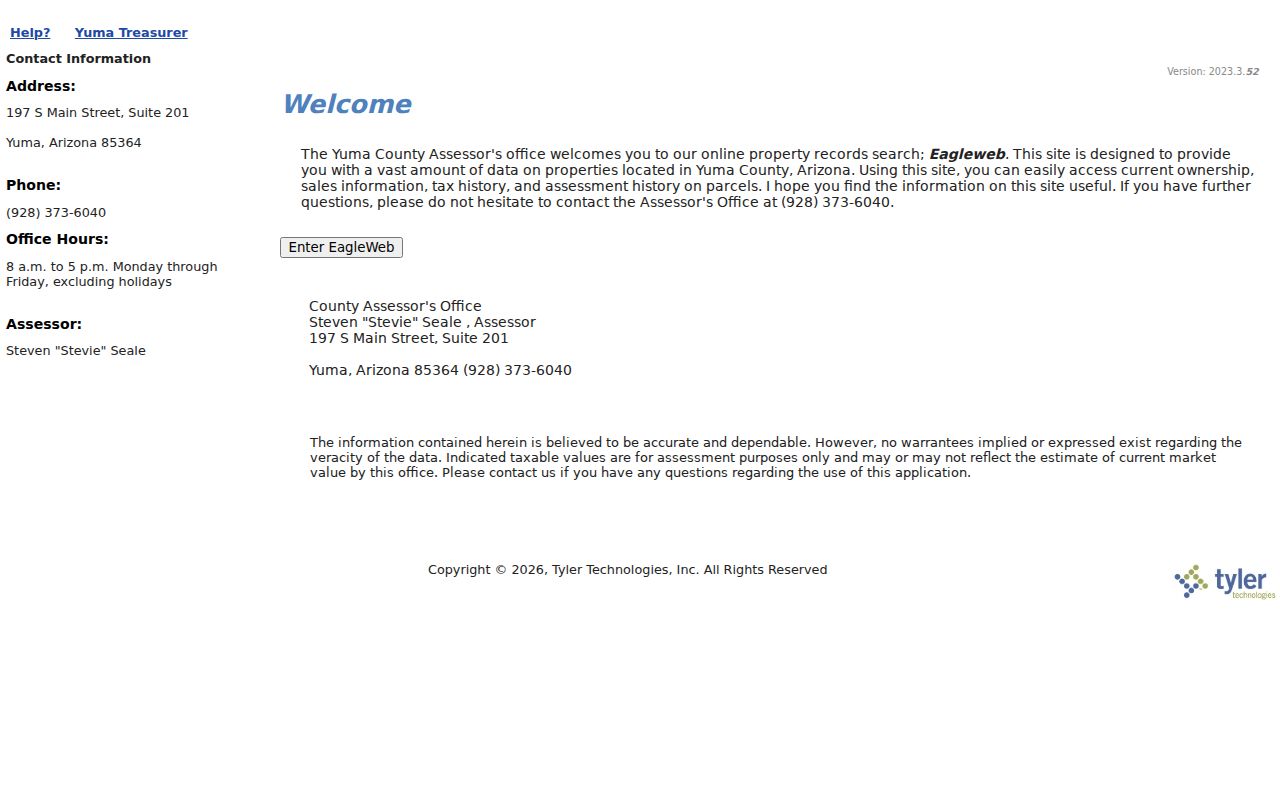
Its field structure helps keep a parcel location separate from the owner's mailing contact. An assessment class can add context, but it is not a household roster and does not prove who occupies the site.
Follow Yuma Recorder Names
The Recorder index works like a card catalog for official instruments. Search names as grantor and grantee, then match the document type, date, recording number, book and page, and legal description. A grantor transfers or encumbers an interest. A grantee receives the interest or benefit. Street addresses are weak keys for old deeds, so the parcel's legal description is vital.
- Index
- A finding tool that points to an official record.
- Parcel
- A mapped unit of land identified by the county.
- Grantor and grantee
- The giving and receiving parties named in an instrument.
- Criss-cross directory
- A directory arranged by address or street instead of only by surname.
If an image cannot be retrieved, the official copy-request form accepts party names, document type and date, grantor, grantee, book/page, or fee number. Copies cost $1 per page and certification adds $3 per document. Staff may take up to ten working days to search, and the form states that the office does not conduct chains of title.
Check Yuma Court Matches
The Arizona Public Access case lookup accepts a party name or case number after a verification step. A name result may show the court, case number, filing date, party role, status, judge, and eligible docket events. Data from participating courts is updated weekly. The result is an index entry, not the official court file.
The statewide Yuma court search screen appears below.
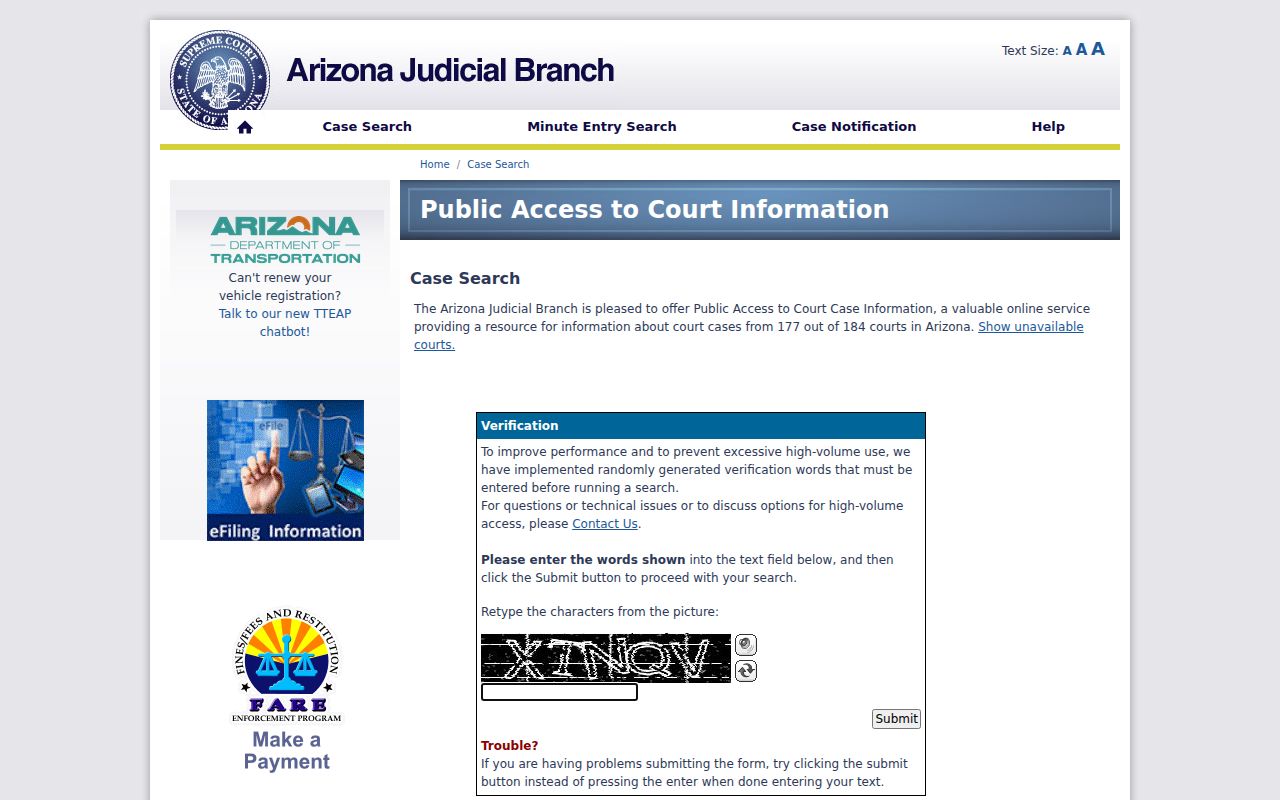
Sealed cases, protection orders, mental-health matters, probate cases, victim and witness data, juvenile matters, and some local charges are excluded. Save the court and case number, then verify the match with that court. City-code and misdemeanor files may require the Yuma Municipal Court. Eligible Superior Court civil and criminal documents filed from July 1, 2010 may be available through paid eAccess. Federal District of Arizona cases use PACER, while other unavailable files require the responsible clerk or archive.
Respect Yuma Voter Lookup Limits
My.Arizona.Vote is a personal registration check, not a name-only public street roll. The voter supplies a county, surname, date of birth, an identifying method and number, plus verification. A match can return the user's registration status, districts, notices, ballot-by-mail status, and whether the voter took part in an election. It never reveals ballot choices.
The Arizona voter self-service form is captured here.
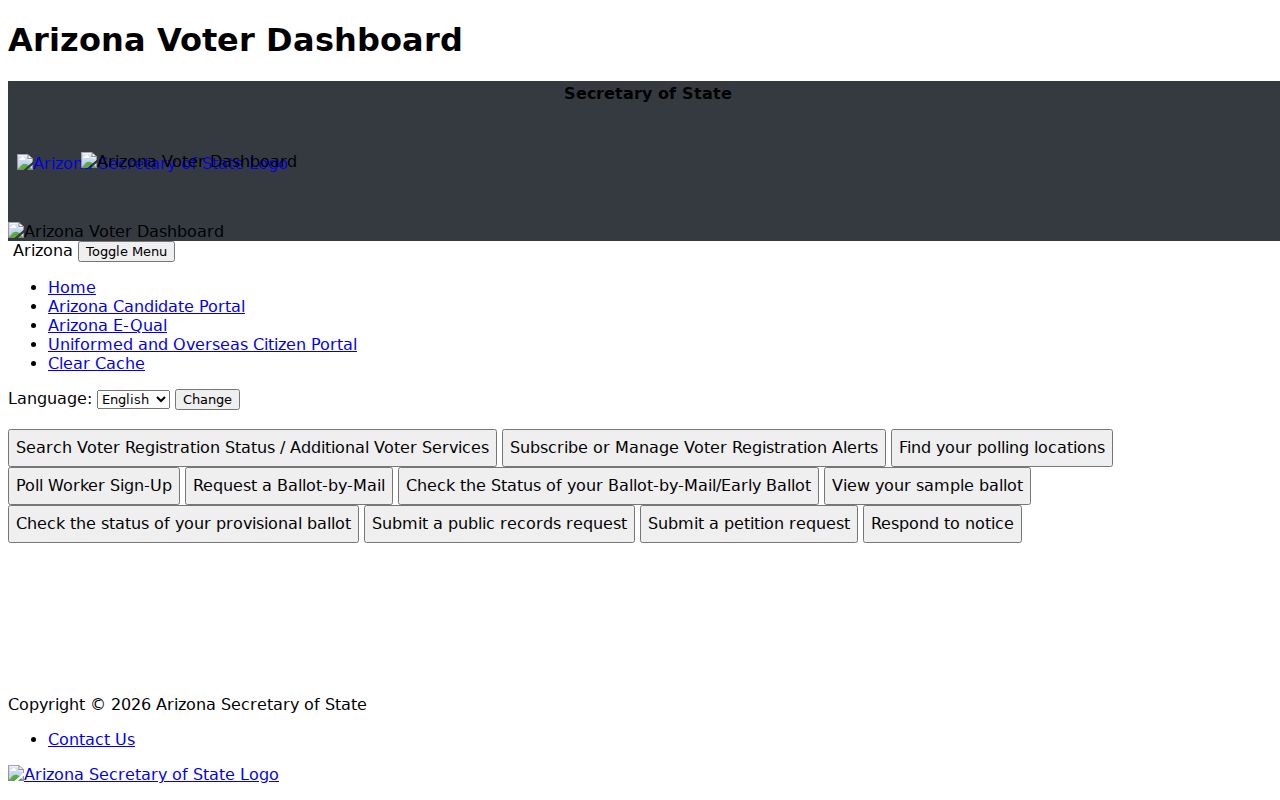
A.R.S. § 16-168 governs authorized voter-file access. Protected addresses and confidential identifiers are withheld. Yuma County Voter Services handles the fuller request process, which requires a permitted purpose, supporting information, payment before release, and may take up to 30 days. Historical Great Registers and pre-1950 precinct lists belong to the archival path instead.
Current Yuma Resident Rolls
Current directory-like sources differ in scope. The property roll lists assessed ownership, not all residents. Recorder instruments list parties to transactions. Court entries list parties in eligible cases. Corporation and license files document public roles at a point in time. The voter portal confirms only the searcher's own record unless a lawful file request applies.
| Official source | What it can confirm | Access route | What it cannot prove |
|---|---|---|---|
| Assessor roll | Assessed owner and parcel link | Free EagleWeb search | Full household |
| Recorder index | Party to a recorded instrument | Index, counter, copy request | Current occupancy |
| Court index | Public case participation | Public Access and clerk | Every case or document |
| ACC entity search | Filed agent or principal role | Free entity search | Private residence |
| Voter self-service | One voter's own registration | Identity-verified portal | Public block roster |
Commercial compilations may merge old sources, but they do not replace official custodians. The Yuma resident lookup workflow shows how to verify one person without treating any single result as final.
Route Yuma Vital Records
Birth and death certificates for Yuma events pass through the Yuma County Public Health Services District or Arizona Department of Health Services. Current certificates are closed records. Eligibility, identification, proof of relationship or legal interest, and the current application fee apply. Public genealogy access begins 75 years after birth and 50 years after death through the Arizona Genealogy Record Search.
Marriage licenses and divorce decrees follow a different route. The Yuma County Clerk of Superior Court holds them, not the state vital-record bureau. Probate may help an heir search, but probate cases are excluded from the statewide web lookup. Give the clerk a decedent name and approximate filing year, then ask about the public file, archive location, and redactions.
For family reconnection involving adoption records, Arizona's Confidential Intermediary Program is the lawful route. Certified intermediaries may search protected records for authorized purposes and exchange identifying information only with consent.
Explore Yuma Library Name Trails
The Arizona Room at Yuma Main Library holds sources that reach beyond modern portals. Newspaper microfilm spans 1872 through 2011 and is available only at the Main Library with staff help. Selected Arizona census films, school registers, yearbooks, church records, mortuary indexes, cemetery compilations, Great Registers, and organization files can distinguish people whose names changed or vanished from a printed directory.
Special Collections is on the second floor at 2951 S. 21st Drive. Researchers can call 928-314-2463 or email SpecialCollections@yumalibrary.org before visiting. Give the surname, time range, and record type. The library's licensed Ancestry access is in-building, while Fold3 and HeritageQuest require a library card. Save a full citation from each film or volume.
Yuma's long local runs are unusually useful. Immaculate Conception registers begin in 1866. Mortuary and cemetery compilations cover much of the twentieth century, while Crane, Yuma High, and Kofa collections add school-year evidence. These sources can connect relatives, classmates, and deceased residents, but they do not state present residence.
Browse Historical Yuma Directories
The verified digitized Yuma Directory Co. run covers 1948, 1949, and 1951 through 1963. No 1950 item appears in that verified 15-volume set. Separate City of Yuma telephone books cover 1942 through 1947, a 1947-48 issue, and periodic editions from 1949 through August 1952. The Yuma city directory collection explains each run and how to read its abbreviations.
A directory entry may show an abbreviated given name, spouse, work description, street address, and telephone exchange. OCR errors are common, so browse the alphabetical neighborhood and try initials or both parts of a Spanish compound surname. Some volumes include valley communities, the proving grounds, Bard, and Winterhaven. A missing city entry can reflect geography or military movement, not necessarily a permanent departure.
Directories work best beside the public 1950 census, local newspaper film, deeds, vital indexes, and the seven Yuma Sanborn editions dated from 1893 through 1948. Each source fixes a person or structure to its own date. None proves uninterrupted residence between those dates.
Request Missing Yuma Records
Arizona Public Records Law, A.R.S. §§ 39-121 through 39-161, provides inspection during office hours subject to confidentiality laws and the best-interests balancing test. The law calls for a prompt response, not one universal fixed number of days. A useful request names the custodian, record series, person or address, date span, and preferred format.
The City Clerk at One City Plaza routes municipal requests for council records, boards, permits, code cases, and other city files. Police, emergency medical, and Municipal Court records have separate channels. County parcel site plans and permits, mostly after 1975, can be requested through Development Services at 2351 W. 26th Street. Court records go to the court that owns the file.
The Arizona public-records statutes are shown in this source capture.
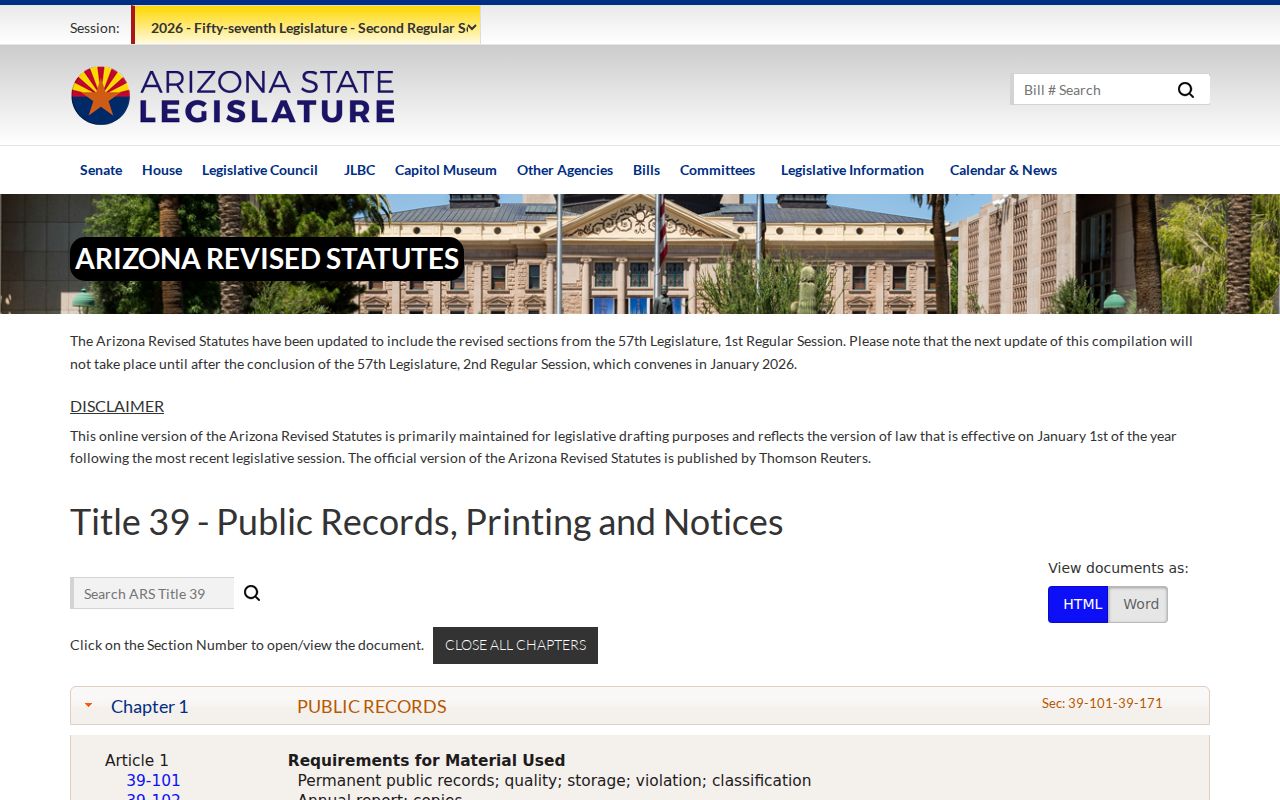
The statute is the request framework, while separate confidentiality rules still control voter details, vital certificates, protected addresses, sealed cases, and other restricted material.
Protect Yuma Resident Addresses
The Arizona Address Confidentiality Program gives qualifying protected people a substitute address and mail forwarding. Participants use a special voter-registration path. Related Arizona provisions allow certain recorder, assessor, and treasurer redactions. A protected address should never be rebuilt by combining scattered directory clues.
The official confidentiality program page is pictured here.

Suppression from a commercial listing is separate from correcting a public record. An assessor error goes to the Assessor; an instrument index issue goes to the Recorder; a court docket issue goes to the court; and a voter record goes to County Voter Services. Never try to defeat a statutory closure through another database.
Verify Yuma Directory Matches
Normalize the name before drawing a conclusion. Search suffixes, initials, married names, compound surnames, and common OCR errors. Then compare at least two independent anchors such as a middle initial, spouse, date range, parcel legal description, entity role, or court number. A matching mailing address alone is weak because it may be a post office box, agent, office, or another property.
| Evidence | Strength for its own fact | Follow-up |
|---|---|---|
| Certified custodian record | Strongest for the fact legally recorded | Check date and scope |
| Current official index | Strong lead | Open or request source record |
| Contemporary directory or census | Good date-specific evidence | Compare adjacent years |
| Later compilation | Finding aid | Locate the original |
Conflicts should remain visible. A deed records a transfer, an assessment shows tax-roll status, a directory records a publication-era listing, and a court portal gives an unofficial case index. They are not interchangeable claims.
Read Yuma Records History
Yuma was one of the Arizona Territory's original counties in 1864. Catalog searches may also need the earlier place name Arizona City, used before the 1873 rename. Territorial records, old plats, church registers, and Spanish or Mexican sources may be relevant for families tied to the Colorado River crossing and land south of the Gila.
Courthouse fires occurred in 1926 and 1927, but the cited sources do not show that a record series was destroyed. That distinction matters. Recorder preservation work later identified historical official records from 1864 through 1993 and sometimes required exact docket, page, or document identifiers while images were handled. The lesson is to locate a precise citation, not assume a missing screen means a lost record.
Street history creates another trap. Brinley Avenue became Madison Avenue, and flood-related rebuilding changed Main Street's building stock after 1916. Old directory addresses, Sanborn footprints, legal descriptions, and present parcels must be aligned before claiming that today's structure housed the person named in an early roll.