
Browse Yuma City Directory Runs
The core Yuma city directory run is the Yuma City-County Directory and Cosmopolitan Telephone Directory, published by Yuma Directory Co. Fifteen verified volumes are available through Arizona Memory. They cover 1948, 1949, and every year from 1951 through 1963. No 1950 item appears in that verified set. That gap must be treated as a collection gap, not proof that no directory was issued.
| Yuma collection | Years represented | Repository | Access route |
|---|---|---|---|
| City-county directories | 1948, 1949, 1951–1963 | Arizona Memory | Digitized and searchable online |
| City telephone books | 1942–1947, 1947–48, semiannual issues in 1949–1952 | Yuma Main Library | Genealogical Society holdings, Books 68–69 |
| Local newspapers | 1872–2011 | Arizona Room | Main Library microfilm with staff help |
| Federal census | Public through 1950 | NARA and library resources | Online databases; selected library microfilm |
| School registers and annuals | Runs from 1904–2011, with gaps | Yuma Main Library | Finding aid and staff-assisted research |
The telephone books start earlier and sometimes provide two checks in one year. Newspapers extend the trail in both directions. Census schedules add whole-household context, while school sources can connect a pupil, parent, address, or photograph to a stated year. None of these sources proves continuous residence between publication dates.
Yuma City Directory Timeline
The verified timeline reveals both depth and limits. Yuma’s business-directory ephemera begins in the 1870s, but the known phone-book series begins in 1942. The digitized Yuma Directory Co. sequence starts in 1948. It reaches 1963, yet the research does not confirm a last printed year or a later physical criss-cross run. Claims should stop where the catalog evidence stops.
| Date | Directory milestone |
|---|---|
| 1870s | Business-directory ephemera begins to appear in local collections. |
| 1942 | The verified City of Yuma telephone-directory holdings begin. |
| 1948 | The digitized Yuma City-County run begins. |
| 1950 | No item is verified in the fifteen-volume digitized set. |
| 1963 | The verified digitized sequence ends; no last-print claim is supported. |
That missing 1950 volume is a useful Yuma quirk. Search the January and July 1950 telephone books, newspapers, census, and the city directories on either side before deciding that a person had left town.
Decode Yuma City Directory Entries
A Yuma city directory line compresses several clues. A 1957 example names Alex Crawford, places Beatrice in parentheses, abbreviates his trade, marks the home address, and supplies a telephone number. A 1962 listing such as “Robt H Werley” shows why initials and shortened given names matter. The entry is evidence of a publication-time association, not a deed or a guarantee that every household member was listed.
| Name form | Surname and given name may be shortened, initialized, or affected by OCR. |
|---|---|
| Spouse | A name in parentheses can supply a strong same-name check. |
| Work clue | An abbreviated occupation or employer may distinguish two residents. |
| Address | A house number, direction, street, route, or box anchors the listing. |
| Telephone | The exchange and number can connect nearby editions or other records. |
Photograph or save the abbreviation page with each entry. One letter can change the meaning of a line. Rural listings may use routes, boxes, mileage, or directions instead of the street form seen today.
- Criss-cross directory
- A directory arranged by street or telephone number rather than only by surname.
- Householder index
- An address-order list used to identify the named subscriber or listed resident at a place.
- Abbreviation key
- The publisher’s legend for short forms such as occupations, address marks, and name notes.
Search Yuma City Directories Online
The 1948 Yuma directory and 1949 Yuma directory provide direct entry points into the digitized run. Search text is helpful, but optical character recognition, or OCR, can split a word or mistake a letter. Browse the alphabetical pages around an expected surname when a text query returns nothing.
The 1948 Arizona Memory screen shows how the digitized collection is presented:
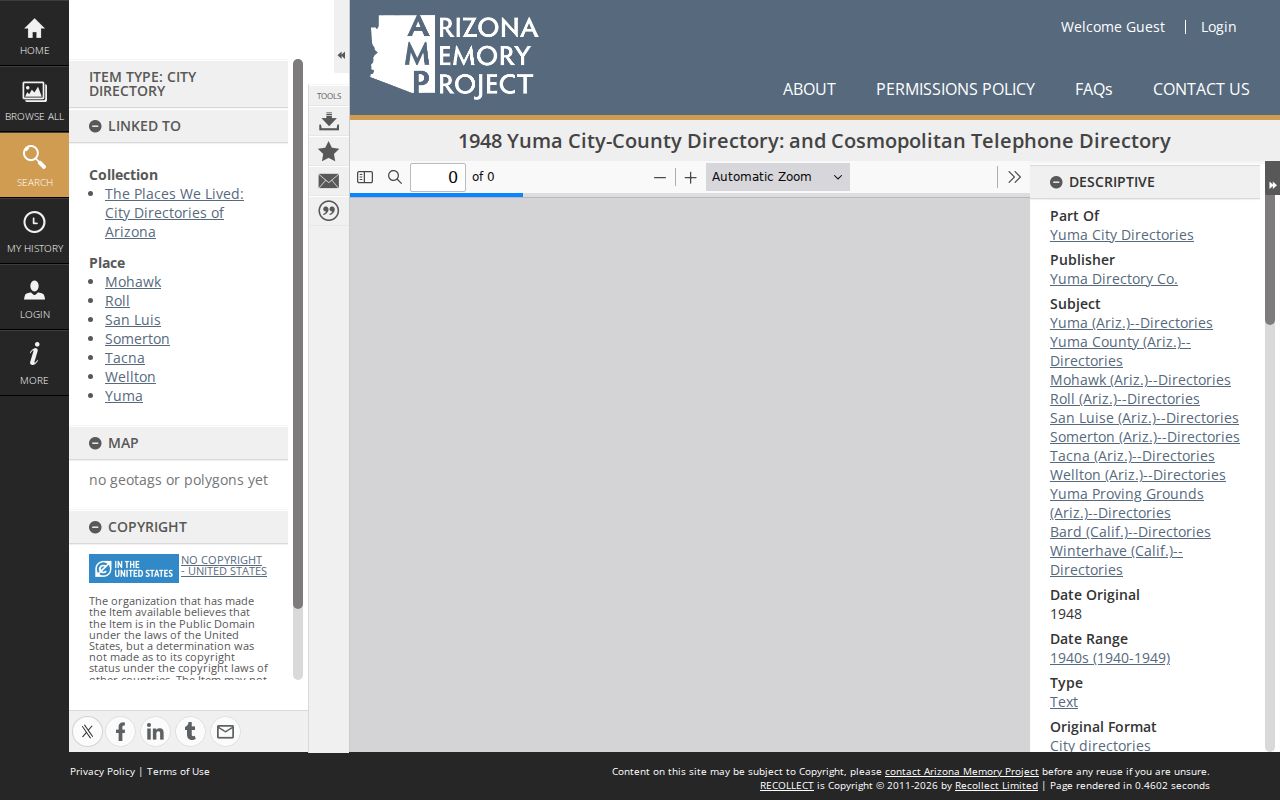
The catalog view fixes the source title and year before names are copied, which helps keep citations tied to the right volume.
The 1949 volume record can then be checked as the next dated snapshot:
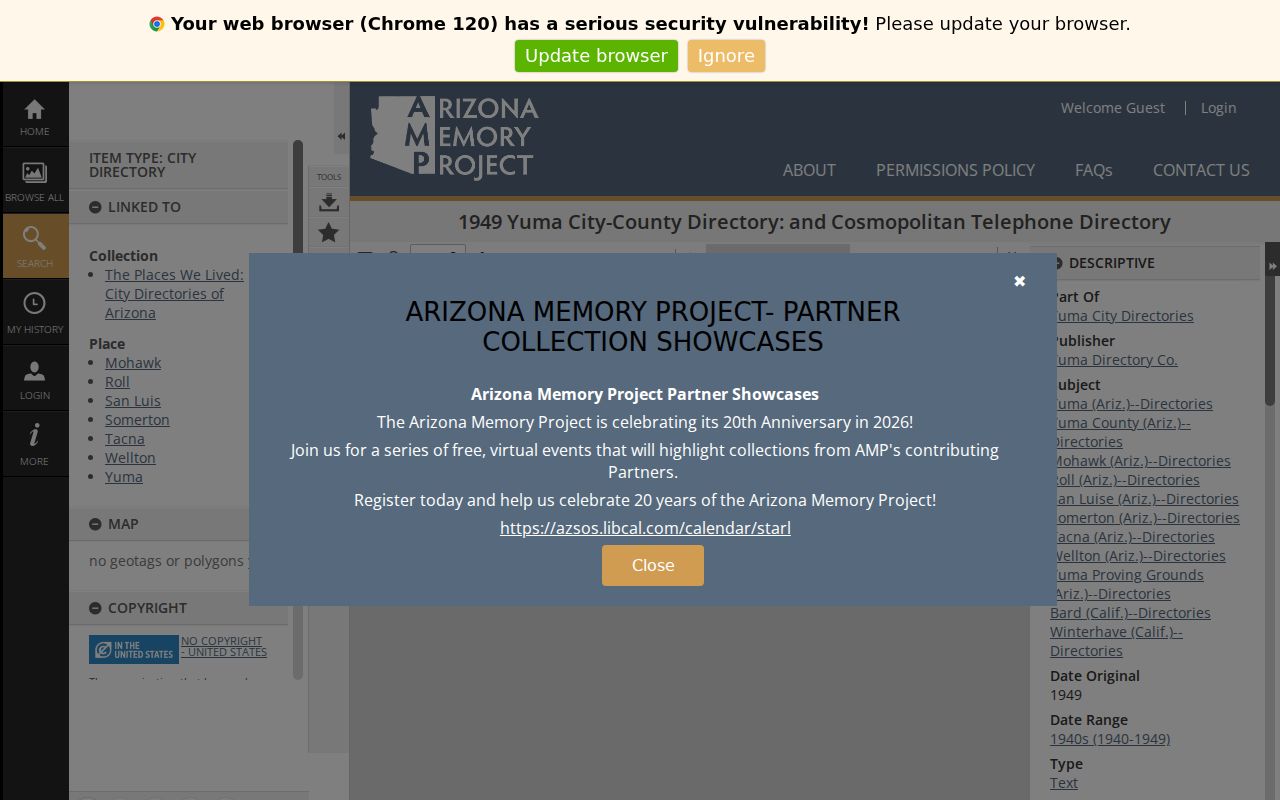
Comparing the two screens reinforces a sound method: save the volume year, page, spelling, address, and phone together rather than copying a bare name.
Yuma City Directory Geography
The word “Yuma” on a volume does not mean every listing fell inside the city limit. Metadata for the 1948 directory includes Mohawk, Roll, San Luis, Somerton, Tacna, Wellton, Yuma Proving Grounds, Bard, and Winterhaven, California, as well as Yuma County. A household can disappear from one city heading yet remain elsewhere in the same regional book.
Military movement adds another layer. Yuma’s airfield lineage runs through a wartime base, Air Force use, Navy transfer, and the MCAS designation. Residents tied to the installation may appear for short spans under a rank, initials, base address, or post-office box. Cross-border and farm work also make Spanish compound surnames, married-name forms, and Anglicized given names worth testing.
Note: Search the full volume geography before treating a missing Yuma heading as evidence that a household moved away.
Research at Yuma Main Library
The Arizona Room at Yuma Main Library is the local access point when the web run ends. It is on the second floor at 2951 S. 21st Drive. Special Collections can be reached at 928-314-2463 or SpecialCollections@yumalibrary.org. The library’s newspaper microfilm is available only there with staff help, so a surname and date range should be supplied before a visit.
Arizona Room
Yuma Main Library
2951 S. 21st Drive
Second floor
Special Collections
928-314-2463
SpecialCollections@yumalibrary.org
Staff-assisted access
The local film span reaches 1872–2011 across successive newspaper titles. Arizona census microfilm for 1880, 1910, and 1920 is also identified. Ancestry Library Edition must be used in the library, while Fold3 and HeritageQuest require a card. The Heritage Library basement adds manuscripts, photographs, and oral histories about local people and places.
Trace Yuma City Directory Households
Family-history work improves when each city directory fact is treated as one dated point. Start with the alphabetical listing, then record every field that can separate one person from another. Move to adjacent editions. A change in spouse, trade, employer, phone, or address can be as useful as the name itself.
- Find the surname and browse nearby spellings, initials, and both parts of a compound surname.
- Record the volume year, page, spouse, work clue, address, and telephone number.
- Check the next and prior available Yuma city directories, including telephone books near the 1950 gap.
- Pair the directory address with the public 1950 census or the library’s selected earlier census films.
- Use newspapers, deeds, vital indexes, or mortuary files to explain the first or last appearance.
A vanished listing can mean a move, death, unlisted telephone, military transfer, publication omission, or shift into an outlying-community section. The Yuma resident lookup offers the modern one-person verification route after a historical identity is established.
Beyond Yuma City Directory Volumes
Yuma’s companion collections can bridge decades outside the printed run. The Genealogical Society inventory lists Crane registers from 1904–1940, Yuma High material from about 1908–1939, Yuma High yearbooks from 1924–1947 with gaps, and Kofa annuals from 1960–2011. A register may connect a pupil, parent, address, and date. An annual may add a photograph or stated affiliation.
Church and end-of-life records are especially strong. Immaculate Conception registers begin in 1866. Methodist records start in the 1890s, and St. Paul’s Episcopal material spans 1919–2007. Johnson Mortuary compilations begin in 1904, with other local mortuary and burial runs extending well into the modern era. The library’s Ephemera Collection and Small Manuscript Collection add clubs, public bodies, families, and local institutions.
These are historical associations, not current resident lists. Keep each citation separate when spellings or dates conflict, then prefer the controlling civil record when it is public and available.
Yuma’s Fire Record Caution
County history records courthouse fires in 1926 and 1927. The first followed a lightning strike to the dome, and firefighters saved the structure. No cited source says a records series was destroyed. A family-history note should never turn those events into a “lost records” legend.
When a Yuma city directory search fails, use the documented alternatives: adjacent volumes, telephone books, newspaper film, census schedules, church registers, mortuary compilations, school material, Great Registers, and coroner files. The Arizona State Archives keeps county-created material under the county and offers catalog searches, collection browsing, and staff access in Phoenix. A failed web query is a reason to change channels, not to invent a gap.
Another local bridge is the library’s Public Records Incorporated collection. Weekly sheets compiled material from city and county government sources. The publication changed from The Record Reporter to Public Records Inc. in 1974 and incorporated in 1976. It can help locate a dated civic mention when the original evidence is scattered among several offices.