
Choose a Yuma Lookup Record
Each Yuma resident lookup source proves a different fact. The Yuma County Assessor connects a recorded owner with a parcel and tax-mailing address, but not with every occupant. A recorded deed connects named parties with an instrument. Arizona Public Access identifies names in eligible cases, while the Arizona Corporation Commission records a person's filed business role. Historical vital indexes answer older birth and death questions. Start with the row that fits the fact at hand, then use a second source to test the match.
| Record | What It Confirms | Where to Search | Access |
|---|---|---|---|
| Property roll | Owner, parcel, situs, and tax-mailing address | Yuma County Assessor EagleWeb | Free guest search |
| Voter record | The searcher's own status, districts, and participation | My.Arizona.Vote | Identity-verified self-lookup |
| Court index | Eligible case, party role, status, and docket facts | Arizona Public Access | Free index; official file at court |
| Vital history | Eligible older birth or death event | Arizona Genealogy Record Search | Birth after 75 years; death after 50 |
| Business filing | Entity, agent, principal, and filing date | ACC Entity Search | Free public search |
| Probate or marriage | Estate interest or marriage-license record | Yuma Clerk of Superior Court | Counter or records request |
A name-only query is weakest. Add a middle initial, spouse or relative, date range, parcel description, business role, or court number. For Yuma names with two surnames, run each part and the full form. Keep results separate until two anchors agree. That simple rule prevents a same-name match from turning into a false identity claim.
Search Yuma Court Names Carefully
The statewide Public Access to Court Information search begins with verification characters, then accepts either a party name or case number. A party query requires the last name and can use a first name plus a Yuma court or county filter. Results can show the court, case number, title or type, filing date, party role, status, judge, docket events, and hearing dates. A docket is the court's dated list of filings and events.
Coverage is broad, not complete. The portal reports data from 177 of 184 Arizona courts and updates weekly. Sealed cases, protection orders, mental-health matters, probate, victim or witness data, juvenile matters, local ordinance charges, and some administrative functions do not appear. A missing result does not prove there was no case. Save the court and case number from any match, then ask the court that holds the official file.
| Public result field | How it helps identify the right person |
|---|---|
| Party name and role | Separates a named participant from the case title |
| Court and case number | Provides the exact key for clerk verification |
| Filing date and case type | Tests the event against the known time and context |
| Status or disposition | Shows the indexed outcome, subject to official confirmation |
| Docket and hearings | Supplies dated events, not basic document images |
Public Access is an index, not an image of the official file. Arizona eAccess offers paid documents for most eligible Superior Court civil and criminal filings from July 1, 2010 forward. The contrast matters: free weekly case data can locate a file, while paid eAccess may deliver an eligible document. The Yuma clerk remains the source for inspection, ordinary copies, or certified copies.
Confirm Yuma Resident Business Roles
A public business role can distinguish two residents with the same name. The Arizona Corporation Commission Entity Search accepts an entity name, statutory agent name, principal name, or entity ID. Optional filters include entity type, status, name type, and county. A result can show the entity ID, name, type, status, formation facts, principal office, statutory agent, principals, and filed document images.
The filing proves a role and an address as of its date. It does not prove a home address. Confirm a regulated role through the relevant board reached from the Arizona professional-license directory. City business-license material adds a local operating clue, while Arizona Secretary of State records cover trade names and UCC filings. Those sources identify affiliations, and each should stay within that limit.
The live ACC search screen shows the public route used in a business-linked Yuma resident lookup.
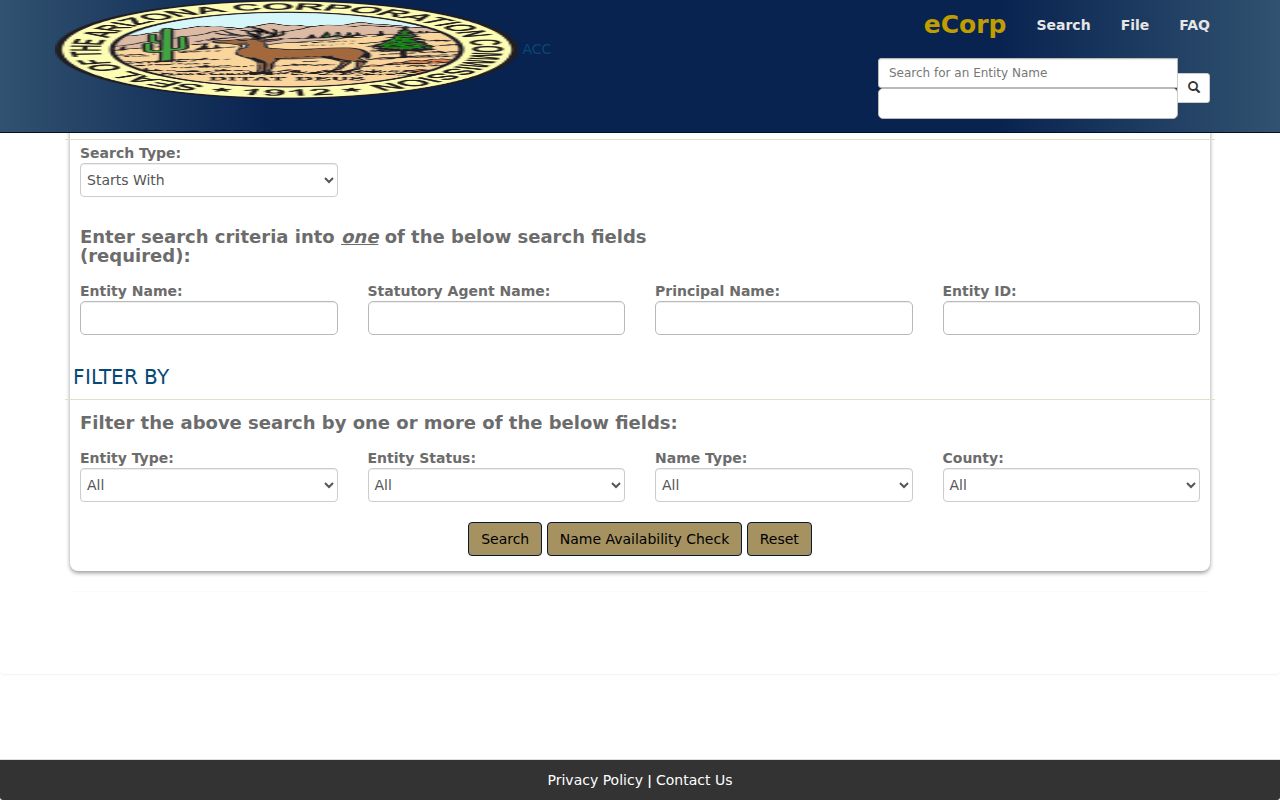
The screen is most useful when a known company, agent, or principal gives the name match a second firm anchor.
Note: A principal-office or statutory-agent address is a filing fact, not proof that the named person lives at that address.
Check Yuma Unclaimed Property
The Arizona Department of Revenue Unclaimed Property route can connect a person or business name with an Arizona last-known address. Search and claims are free. Under A.R.S. § 44-315, the property source and value stay confidential unless the claimant authorizes disclosure. The agency also states that no bulk owner list is available.
This clue fits heir and family research when an address or name is already known. It should not stand alone in a resident lookup. Compare the displayed name and location with an obituary, probate transfer, parcel, or entity filing. An apparent match still requires the claimant process and proof set by the state.
The official Arizona unclaimed-property page makes clear where the free search begins.
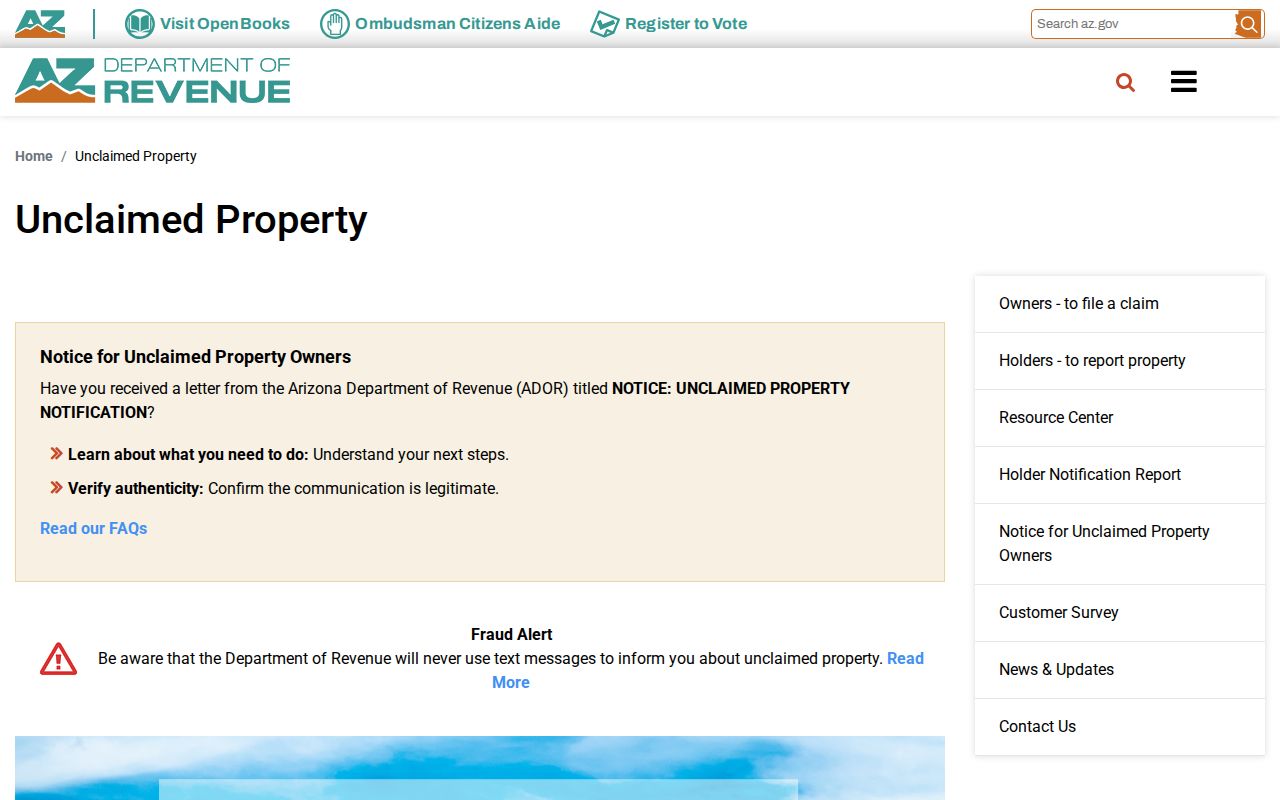
That source can supply a lead without exposing the confidential property details reserved for an authorized claimant.
Verify One Yuma Resident
A sound resident lookup moves from a broad name to two independent anchors. Use the source that best fits the known clue, preserve the exact query, and note the record date. Do not blend a current assessment, an old directory entry, and a court index as though all describe the same moment. Each record answers its own question.
- Normalize the name. List initials, suffixes, married names, accents, and both parts of a compound surname.
- Anchor the person to a dated fact. An assessor parcel, entity role, obituary, or known case number can narrow the field.
- Search a second official index. Compare the date, middle initial, relative, address, parcel description, or public role.
- Contact the custodian when the web result matters. Ask for inspection, an ordinary copy, or a certified copy of the exact record.
- Docket
- The dated court list of filings, hearings, and case events.
- Index versus image
- An index points to a record; an image reproduces the filed document itself.
- Certified copy
- A custodian-issued copy bearing formal proof that it matches the held record.
If the search shifts from one name to everyone along an address, use the Yuma street directory workflow. It keeps parcel and street research separate from one-person identity checks.
Trace Yuma Vital Events
Arizona treats current birth and death certificates as closed vital records. Qualified applicants use the Yuma County or Arizona Department of Health Services process, show identification, prove eligibility, and pay the current fee shown on the official application. Marriage-license copies and divorce files come from the Yuma Clerk of Superior Court, not ADHS.
For family history, the Arizona Genealogy Record Search opens a practical historical route after 75 years for births and 50 years for deaths. Try variants and a broad year span. A historical index entry is less detailed than a certificate, but it can lead to a cemetery file, obituary, probate matter, deed transfer, or directory entry.
Mortuary, church, and cemetery compilations are especially useful when a Yuma directory trail ends. Johnson, Desert Lawn, Ryzek, and Kammann materials can help distinguish deceased namesakes. Probate is excluded from statewide Public Access, so give the clerk the decedent's name and an approximate death or filing year.
Note: Use the current Arizona application for certificate fees and eligibility because the official forms changed during the research period.
Yuma Adoption Contact Route
Arizona provides a lawful route for adoption-triad searches without trying to defeat a sealed file. The Confidential Intermediary Program was established in 1992 under A.R.S. § 8-134. Certified intermediaries may inspect confidential court, agency, division, and maternity-home records only for the authorized search. Identifying information is exchanged only with consent.
Program contact is the Arizona Supreme Court Administrative Office of the Courts, 1501 W. Washington Street, Suite 104, Phoenix, at 602-452-3378. That state process is the correct starting point for a birth parent, adoptee, or eligible relative. Ordinary court-name searches omit adoption matters and should not be treated as a workaround.
The Confidential Intermediary Program overview shows the authorized contact path.
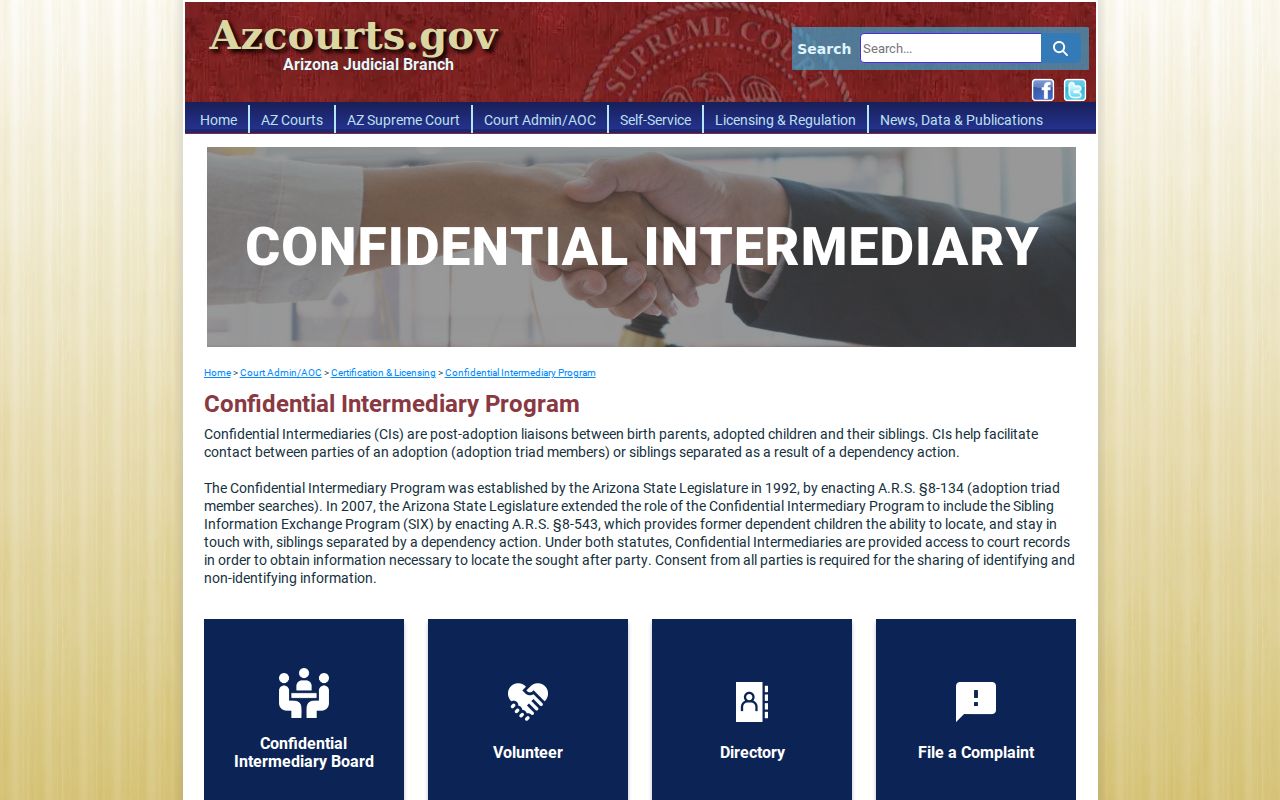
The program protects sealed information while allowing consent-based contact through a trained intermediary.
When Yuma Lookup Portals Fail
No online result may mean the wrong custodian, a spelling change, older-than-web coverage, a protected record, an unincorporated location, or a record that was never created. File a focused Arizona Public Records Law request under A.R.S. §§ 39-121 through 39-161. Name the office, record series, subject, date range, and desired format. Arizona requires a prompt response but does not impose one universal fixed-day deadline.
Use the Recorder copy form for a known instrument. Ask the Yuma clerk whether a court file is onsite, archived, digitized, or available at a public terminal. Older genealogy can move to Yuma Main Library, Arizona State Archives, or Arizona Memory. A custodian can locate a defined record, but staff are not expected to research a complete life history.
Corrections go back to the source. An assessor ownership issue belongs with the Assessor, a recorded index or image issue with the Recorder, a docket issue with the court, and an entity record with ACC. Correcting a private compilation does not alter a government record.
Use Yuma Safety Records Precisely
The Arizona Department of Public Safety offender information is an official, purpose-limited source. Follow its statutory warnings and confirm identity details before treating a name as a match. An index entry does not replace the record held by the responsible agency or court.
The state offender-information page is the proper source for its rules and current search access.
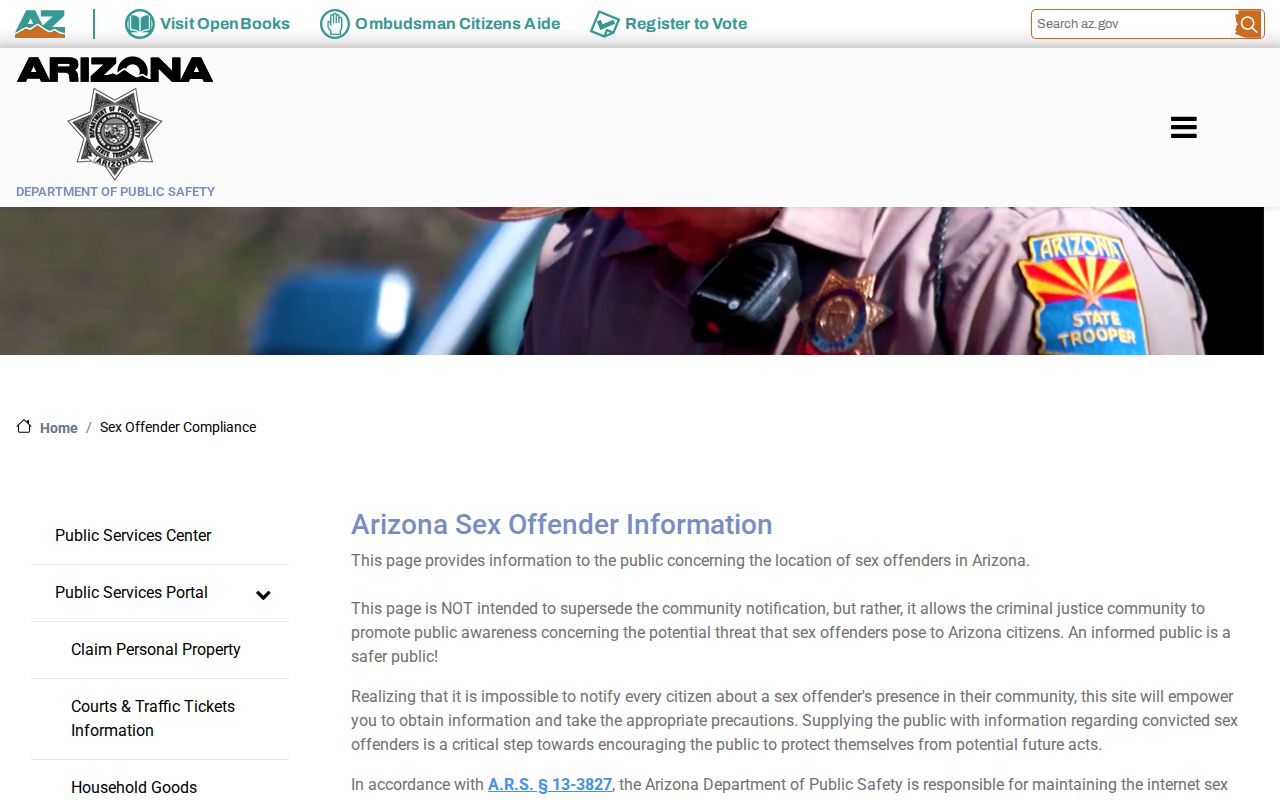
The screenshot reinforces why an official source, its warnings, and exact identifiers belong together in any safety-related check.
Keep Yuma Resident Lookups Lawful
Some Yuma residents have protected addresses. The Arizona Address Confidentiality Program provides a substitute address and mail forwarding for qualifying protected people. Voter records also withhold protected and confidential fields under A.R.S. §§ 16-153 and 16-168. Recorder, assessor, and treasurer redaction processes arise under A.R.S. §§ 11-483 and 11-484.
My.Arizona.Vote is a self-service identity check, not a public name browser. A fuller voter-file request needs a sworn permitted purpose, payment, and statutory review, while protected addresses and sensitive identifiers remain withheld. Participation history can show whether someone took part, never how that person voted.
Lawful use. A Yuma resident lookup is for lawful personal research. Never use a record to stalk, harass, intimidate, or harm anyone.
Private suppression and official correction are different. Removing a result from a commercial compilation does not erase a deed, court index, license, or voter source. Request correction or lawful redaction from the custodian that holds the official record.