
Yuma Previous Resident Sources
One Yuma address can cross modern parcel systems, territorial-era instruments, printed directories, and archival maps. Start with the newest dependable key, then move backward. The era table shows where each source is strongest. It also keeps a record of ownership from being mistaken for evidence of every person who lived there.
| Source | Verified years | Where held | What it can show |
|---|---|---|---|
| Recorded official records | Historical group identified as 1864–1993; web cutoff unstated | Yuma County Recorder index and counter | Deeds, liens, plats, parties, legal descriptions |
| Yuma Title & Trust files | Mortgages from the 1880s; some chains through the 1970s | Yuma Library Special Collections | Maps, surveys, deeds, suits, restrictions, receipts |
| Telephone directories | 1942 through August 1952 in listed editions | Yuma Main Library | Subscriber, address, and telephone |
| City-county directories | 1948, 1949, 1951–1963 | Arizona Memory | Listed occupant, spouse, work, address, phone |
| Federal census | Public through 1950 | NARA and library databases | Household members and relationships |
| Sanborn maps | 1893, 1896, 1901, 1911, 1917, 1927, 1948 | Library of Congress | Structure, use, footprint, and street continuity |
| Parcel permit files | Mostly after 1975 | County Development Services | Building and site-plan chronology |
For a recent chain, begin with the assessor and Recorder. For a mid-century household, use a directory beside the census. Earlier questions often need the title files, Sanborn maps, newspapers, and territorial records.
Start Yuma Resident Records With APN
The Yuma County Assessor EagleWeb record supplies the present owner, situs address, parcel number, legal description, and transfer history. Situs means the physical parcel address. It must stay separate from the tax-mailing address, which may point to a post office box or a place far from Yuma. The parcel number and legal description are the durable keys for prior residents research.
Next, use county GIS to confirm parcel shape, subdivision, and jurisdiction. A legal description can survive a changed street name or number. Save each version exactly as shown, including lot, block, tract, subdivision, and book/page citations. That record log prevents two nearby parcels with similar addresses from being joined by mistake.
Note: A current assessment class or shared mailing address can support a theory, but neither one proves who occupied the property.
Trace Yuma Previous Resident Deeds
The Yuma County Recorder indexes deeds, deeds of trust, liens, releases, plats, and related instruments. Build the chain yourself. The office can retrieve a known document, but its official form says staff cannot conduct chains of title.
- Copy the present APN, legal description, and current assessed owner from EagleWeb.
- Find that owner's acquisition deed, then record its date, fee number or book/page, grantor, grantee, and legal description.
- Search the seller as a grantee in the earlier acquisition. Match the same land and a sound date sequence.
- Repeat backward, testing all spelling variants and checking each indexed entry against the instrument.
- If an image is missing, submit the exact identifier through the official copy form or ask at the Recorder counter.
- Grantor and grantee
- The grantor transfers or encumbers an interest; the grantee receives or benefits from it.
- Chain of title
- The linked sequence of recorded transfers affecting the same land.
- Legal description
- The recorded land description used to match a deed to a parcel despite address changes.
- Fee number
- Yuma County's recording or document identifier used to retrieve an instrument.
Cross Yuma Records Preservation Range
Yuma County's 2023 KoFile project identified official historical records from 1864 through 1993. During the preservation work, an exact docket/page or document number was especially important, and retrieval could take up to five business days. The project is a reason to keep precise citations, not a published start date for the current web index.
The Recorder's Official Copy Request accepts document type, date, names, grantor, grantee, book/page, and fee number. The office may take up to ten working days to search. Copies cost $1 per page, with $3 per document for certification. Staff contact the requester after finding the item, and mailed requests need a self-addressed stamped envelope.
The index functions like a card catalog. The official record is the instrument itself. For material not online, visit or contact the Recorder at 298 S. Main Street, weekdays from 8 a.m. to 5 p.m., 928-373-6020, or Recorder@yumacountyaz.gov.
Yuma Resident Title Files Extend
The Yuma Title and Trust Company Collection is the standout local fallback. Some files trace land from the first Territorial plat sale through the 1970s. The collection includes General, City Blocks, Paving and Sewer District assessments, Subdivisions, and Restrictions series. Its contents may include deeds, maps, surveys, lawsuits, mortgages, tax receipts, and title chains that bridge a modern APN to an older block.
The Yuma Title and Trust collection page provides the source and finding context for the image below.
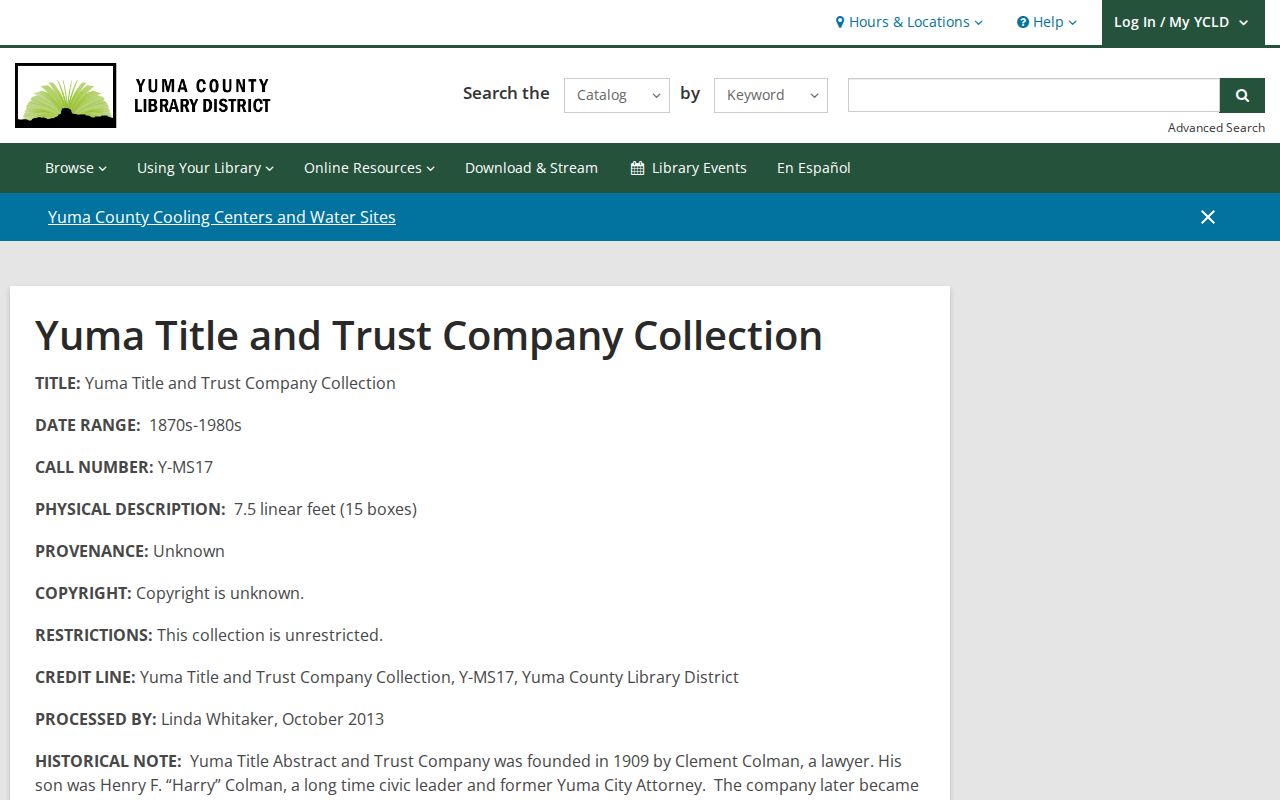
The collection's block files carry dated spans, including blocks 91–100 from 1872–1944 and blocks 131–150 from 1876–1945. Those block-led groups can restore a chain when a modern address search stalls.
These are archival files, not a remote parcel portal. Contact Special Collections at 928-314-2463 or SpecialCollections@yumalibrary.org with the block, subdivision, family name, and date range. The Arizona Room is on the second floor of Yuma Main Library at 2951 S. 21st Drive. Ask which box or finding-aid entry should be requested before a visit. Staff help locates the material, while the researcher still must compare each dated item with the Recorder's official instruments.
Maps Test Yuma Resident Structures
Seven editions in the Library of Congress Sanborn map collection cover Yuma in 1893, 1896, 1901, 1911, 1917, 1927, and 1948. They show building footprints, construction, use, and street patterns. They generally do not name residents. Their role is to test whether today's structure existed when a directory or deed placed someone on the land.
Compare the target block across editions. Note additions, demolitions, address changes, and shifts in use. Then compare the map date with a deed, directory, newspaper item, or permit. A person associated with a parcel before the current building existed was a past resident of the site, not necessarily of the current house.
Yuma's flood history makes that distinction vital. The last major Main Street flood came in 1916, and much of Main Street's present fabric dates from the 1920s, while sheltered Madison Avenue retains earlier buildings.
Previous Residents Across Yuma Street Names
Historic Brinley Avenue became Madison Avenue. Search both names in title files, newspapers, directories, and maps. A gap under the modern street name may be an index problem rather than a move. The legal description and block number provide the safest bridge.
The same rule applies to aliases and the regional grid. Avenue 2E is also Pacific Avenue, and Avenue 6E is also Araby Road in the city street index. Preserve directions, units, rural route forms, and subdivision data. Do not project a modern ZIP backward onto a directory or census schedule that predates it.
Note: Old address forms should be recorded beside the source date, not silently converted to a modern street label.
Pair Yuma Directories and Census
The verified digitized Yuma Directory Co. set includes 1948, 1949, and 1951 through 1963, with no verified 1950 item. A directory can list a resident, spouse, work, address, and phone. The federal census, public through 1950 under the 72-year rule, can add household members and relationships. Neither source proves uninterrupted occupancy between its dates.
- Search a directory by name, then inspect its street or address section where one exists.
- Record spouse, occupation, phone, exact address, and all abbreviations from that edition.
- Repeat in adjacent directory years to bracket an arrival, departure, or spelling change.
- Locate the matching census address or enumeration district and compare names, ages, and relationships.
- Check the deed, newspaper, or vital index when the two sources conflict.
The full collection and entry-reading method are covered on the Yuma city directory page. The YCLD Small Manuscript Collection is another surname and place-based lead.
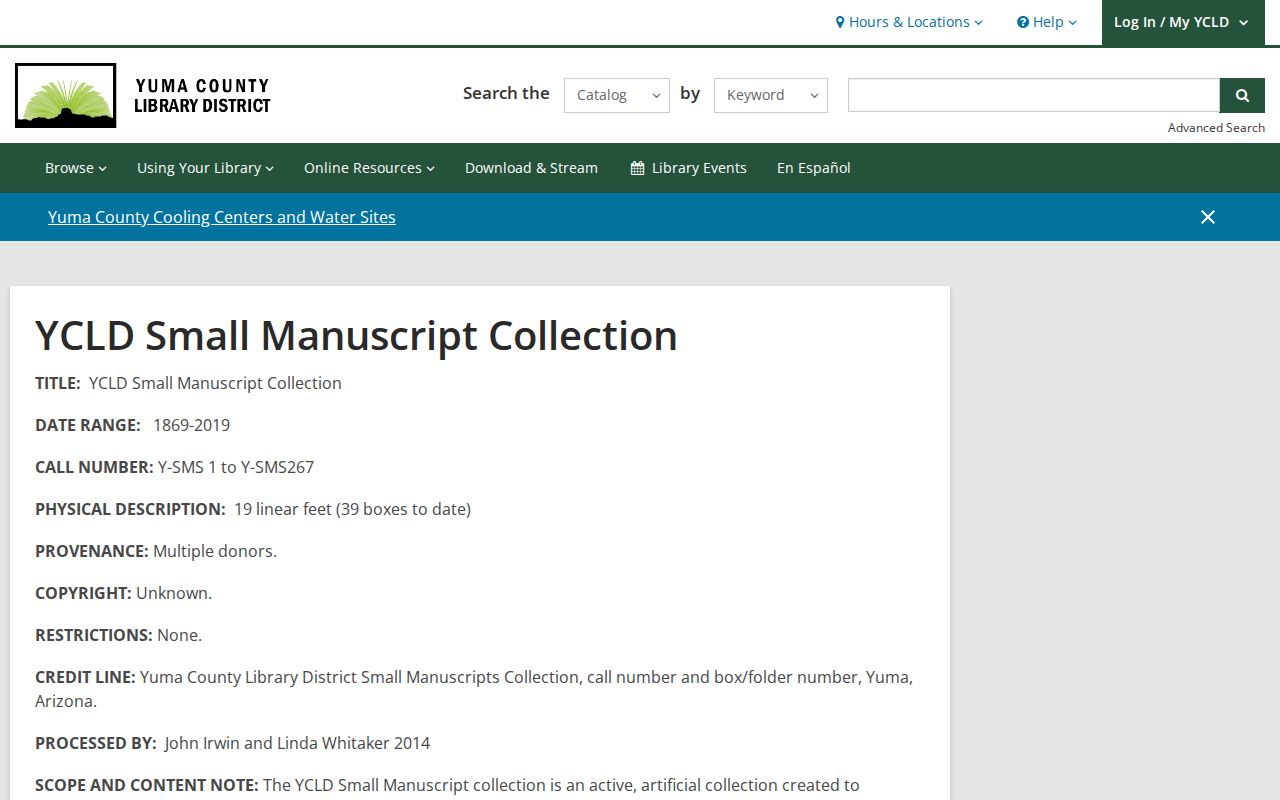
Manuscript descriptions can point to family papers, local groups, photographs, or oral histories that explain why a household appears or disappears from formal rolls.
Yuma Resident Ephemera Bridges Gaps
The Yuma County Library District Ephemera Collection contains files on streets, churches, businesses, civic groups, people, and county records. It also holds State Archives county-record inventories dated 1964 and 2013. Such files can supply a newspaper clipping, program, roster, or local subject reference that points back to a stronger dated source.
The YCLD Ephemera Collection is the official source for the collection view shown here.
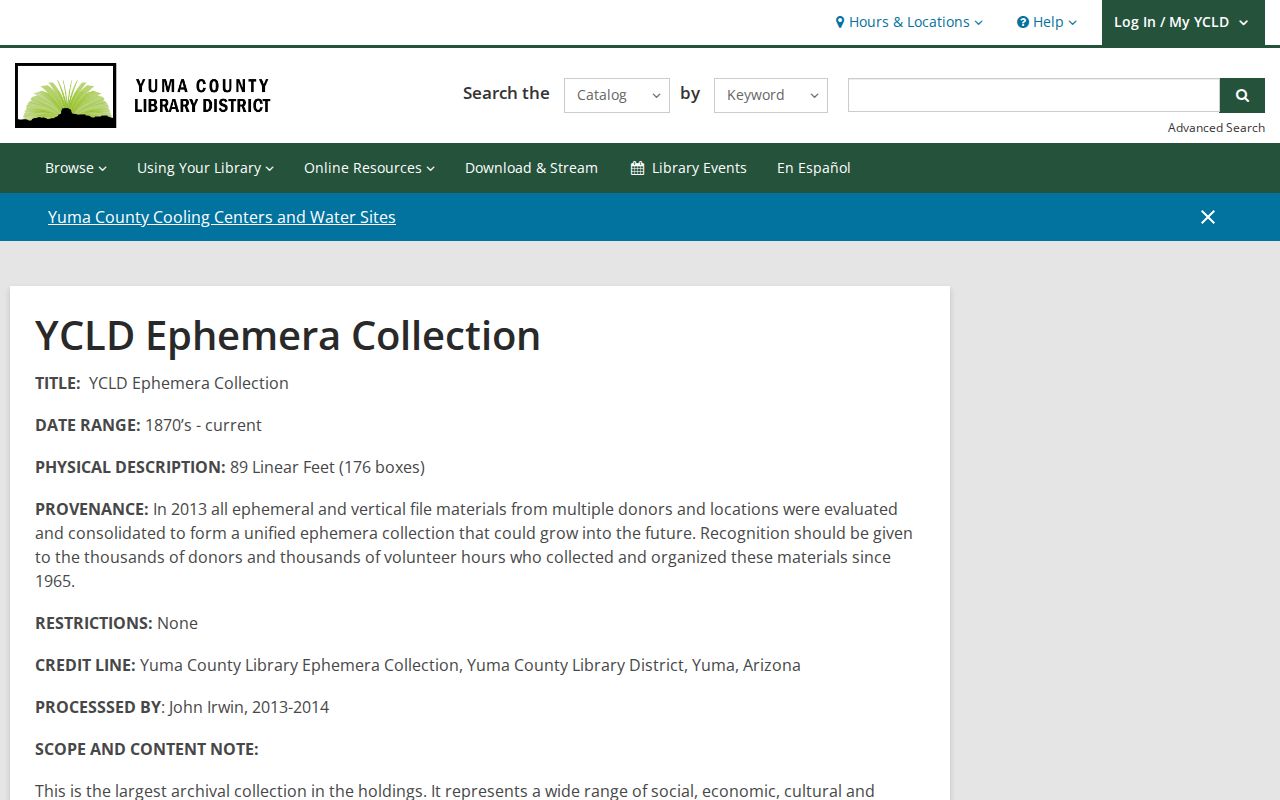
Ephemera can explain local context, but a club file or public roster does not prove current residence. Cite the item, date, and collection, then verify the address link through a directory, deed, census, or other official record.
Close Yuma Past Resident Trails
When a listed person dies or leaves the address, Yuma's newspapers, mortuary compilations, cemetery registers, and probate files can close the trail. Main Library holds newspaper microfilm spanning 1872–2011, available only in person with staff help. Johnson Mortuary compilations begin in 1904 and continue in several books through 2012. Desert Lawn, Ryzek, and Kammann records cover additional periods.
Obituaries may name relatives, a former address, a move, or a funeral home. Probate may connect heirs and land, while a later deed shows how title changed. The Clerk of Superior Court keeps probate records, subject to access limits. Call the Arizona Room at 928-314-2463 or email SpecialCollections@yumalibrary.org before visiting, and provide a surname and date range so staff can identify the right film or box.
A burial register, mortuary index, obituary, and civil death record can disagree. Keep each statement with its source. Use an eligible death certificate as the controlling civil record when available.
Arizona State Archives is the next fallback for territorial and county groups. Its genealogy collection includes assessment rolls, Great Registers, coroner and justice files, and Superior Court marriage, probate, civil, and criminal series. Search by the creating county, name, and date span. Archives staff can help identify a series, but statutory closures still apply.
Lawful use. Research Yuma previous residents for house history, genealogy, heirs, or personal curiosity. Never use an address trail to track, harass, intimidate, or harm a living person.